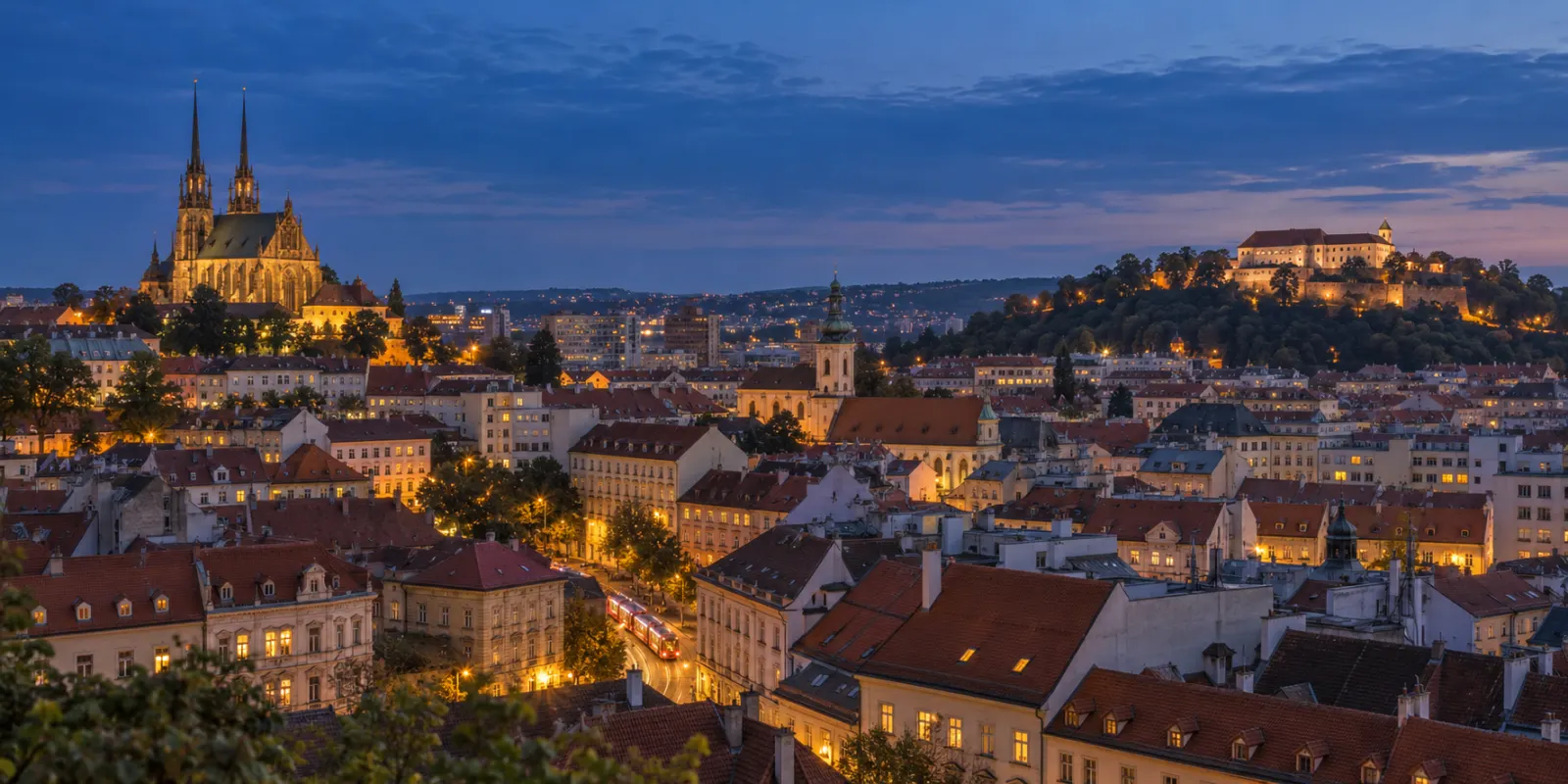
Brno is smaller than Prague, greener and easier to cross, and its neighbourhoods are very different from each other. Veveří and Královo Pole are full of students and cafés, Žabovřesky and Černá Pole are calm and close to the centre, and estates such as Lesná, Bystrc and Líšeň trade the city for forests and the reservoir. Here is what each neighbourhood is like and how it's connected, each with its market live from today's listings.
How is Brno divided?
Brno's 29 districts run from Brno-střed, the centre, to former villages on the city's edge such as Útěchov and Ořešín. Your town hall and your local schools go by district. The neighbourhoods are older: they're the historic cadastral areas (katastrální území), such as Veveří, Staré Brno or Královo Pole, and they don't always follow district lines. Černá Pole, for example, lies partly in Brno-sever, partly in Brno-střed and partly in Královo Pole.
Listings may name the district ("Brno-střed"), the neighbourhood ("Veveří") or both. Two flats with different names can be a street apart, so compare them on a map rather than by their names.
How do you choose a neighbourhood in Brno?
Start from where you'll go every day. Without a metro, the tram line matters more than the distance. A flat by a tram stop on the line to your office or faculty can be quicker than one closer to it on foot. Most lines run through the centre, so a trip between two outer neighbourhoods often means changing there.
Then decide what kind of building you want:
| Building | In Czech | What it's like |
|---|---|---|
| Apartment house | činžovní dům | High ceilings and thick brick walls, often without a lift, from around 1900 |
| Interwar building | prvorepublikový dům | Brno is known for its functionalist architecture of the 1920s and 1930s: light flats, flat roofs, often a lift |
| Panel building | panelový dům | Prefabricated blocks on estates (sídliště), mostly from the 1960s to the 1980s |
| New build | novostavba | Lifts, parking and better energy classes, usually at a higher price per m² |
The live blocks below show each neighbourhood's market today: how many homes are listed, what a two-room flat rents for with charges, the median asking price per m² of flats for sale and how long homes stay on the market. They update every day, so compare them rather than any figure you read elsewhere.
To narrow the list first, the Brno neighbourhood finder ranks every part of the city by your budget, the layout you need and what matters to you, from green space and schools to shops and nightlife, and says why each one is there.
Last, check what's outside the windows. A busy road, a tram line or a street of bars changes a flat more than its neighbourhood does. Visit on a weekday morning and again on a Friday night before you sign.
What is it like to live in the centre?
Město Brno
The historic core, inside the ring of boulevards that replaced the city walls. It runs around náměstí Svobody, the Cabbage Market (Zelný trh) and the Old Town Hall. Petrov cathedral and Špilberk castle stand on their hills above it. Most homes are flats in old apartment houses above shops, cafés and bars, and it's the liveliest part of the city at night, so the quietest flats face a courtyard. The main railway station, Brno hlavní nádraží, is on its southern edge, and night buses leave from it to the rest of the city.
Veveří
North-west of the centre, a dense grid of apartment houses from around 1900. Several faculties of Masaryk University and of the Brno University of Technology are in its streets, so it's full of students, small cafés and bistros. On its western edge, Kraví hora hill has an observatory and an open-air swimming pool. Trams run along its main streets to the centre in a few minutes.
Staré Brno
Below Špilberk and Petrov, south-west of the centre. Its heart is Mendlovo náměstí, where Gregor Mendel worked out the rules of heredity in the garden of the Augustinian abbey, now a museum. The Starobrno brewery is here, and so is St Anne's University Hospital. The exhibition grounds (výstaviště) and the green riverside of Pisárky are a short tram ride further west.
Štýřice
South-west of the centre, between Staré Brno and the Svratka river, with Červený kopec hill above it. Old apartment houses stand beside new flats and offices along the river. The centre and the main station are a few tram stops away.
Which neighbourhoods are north of the centre?
The north of the city climbs gently away from the centre, with universities, parks and one of the country's best-known housing estates.
Královo Pole
The main campus of the Brno University of Technology is here, including its Faculty of Information Technology in a former Carthusian monastery. Apartment houses line Palackého třída, and newer blocks and offices sit behind them. It's popular with students and people working in tech. Trams run down to the centre, and Brno-Královo Pole is a railway station.
Černá Pole
North-east of the centre, on a slope of interwar villas and apartment houses. Villa Tugendhat, designed by Ludwig Mies van der Rohe and on the UNESCO World Heritage List, stands here, and Mendel University has its campus on Zemědělská street. Lužánky, the oldest public park in the Czech lands, is right next to it.
Lesná
A housing estate built from the 1960s on a hill north of the centre, often named as one of the best-planned Czech estates. Its panel blocks stand among lawns and old trees, and the forest begins where the estate ends. Trams run to the centre.
What about the west, Žabovřesky and Bystrc?
The west of the city follows the Svratka river upstream, from quiet streets near the centre to the reservoir.
Žabovřesky
West of Veveří, between Kraví hora and the Svratka. Its streets mix apartment houses with functionalist villas and blocks from the 1920s and 1930s, and Wilson's Forest (Wilsonův les) is close by. It's calm and green, and trams reach the centre in a few stops.
Bystrc
On the city's north-western edge, a large housing estate by the Brno Reservoir (Brněnská přehrada). In summer there are beaches and boats, and all year there are cycling and forest paths around the water. Brno Zoo is on the hill above, and Veveří Castle, not to be confused with the neighbourhood, stands on the reservoir's shore. Tram line 1 runs from the main station through the centre to the reservoir. It's one of the longer rides into town.
What are the neighbourhoods east and south of the centre like?
Zábrdovice
East of the centre, around Cejl street and the former Zbrojovka arms works, which are being rebuilt as a new quarter. It's close to the centre and changing fast. Streets differ a great deal from block to block, and its reputation is mixed, so walk around it before you sign.
Židenice
Further east along the Svitava river: apartment houses near the centre, panel blocks, and family houses on the slopes above. Trams run to the centre, and Brno-Židenice is a railway station.
Trnitá
South of the main station, on former railway and industrial land. The Vaňkovka shopping centre fills a restored engineering works, the Zvonařka coach station is here, and new offices and flats are rising around them. Everything in the centre is a walk away.
Líšeň
On the city's eastern edge, an old village core with one of Brno's large estates beside it. It backs onto the Hády hill and Mariánské údolí, a wooded valley with ponds, and the Moravian Karst begins a little further north. Trams run to the centre.
Bohunice
South-west, an estate on a hill beside the University Hospital Brno (Fakultní nemocnice Brno) and Masaryk University's Bohunice campus, which holds its faculties of medicine and science. Many doctors, researchers and students live here and in neighbouring Starý Lískovec. Trams run to the centre.
How do you compare neighbourhoods on Bytky?
Every neighbourhood has an area page, such as Veveří or Královo Pole. It lists the homes for rent and for sale on a map and in a table and follows the market. It also counts the shops, schools, doctors and parks within walking distance.
The Brno neighbourhood finder puts them side by side: set your budget and the layout you need, say what matters to you, and it ranks every part of the city with the reasons. Trip times in Brno aren't in it yet, so check the tram lines to the places you go to.
When you know where you want to live, draw that area on the map and save the search. Bytky then tells you about every new flat in it, so you can call before the others do. For what renting here costs and how the market works, read renting a flat in Brno.
Here is every flat to rent in Brno on the map. Narrow it with the filters, or zoom into the neighbourhoods above:
What is the best area to live in Brno for expats?
There's no single best one. Veveří and Královo Pole are popular for their streets, faculties and trams, Žabovřesky and Černá Pole for green and calm close to the centre, and Lesná, Bystrc and Líšeň for space and nature further out. Start from where you'll go every day, and compare the area pages.
Does Brno have a metro?
No. Trams are the backbone, with trolleybuses and buses, all on one IDS JMK ticket. Night buses run from the main station to every part of the city.
What's the difference between Brno-střed and Veveří?
Brno-střed is a city district, with its own town hall. Veveří is a historic neighbourhood inside it, alongside Město Brno, Staré Brno, Štýřice and parts of others. Listings often name both.
Where do students live in Brno?
Near their faculties: Veveří and Královo Pole, where many of them are, Černá Pole for Mendel University, and Bohunice for medicine and science. Many share a flat (spolubydlení) or live in a hall of residence (kolej).
How do I find a flat near my work in Brno?
Find the tram lines that go there, then look at the neighbourhoods along them. On Bytky, draw that area on the map and save the search to hear about every new flat in it.