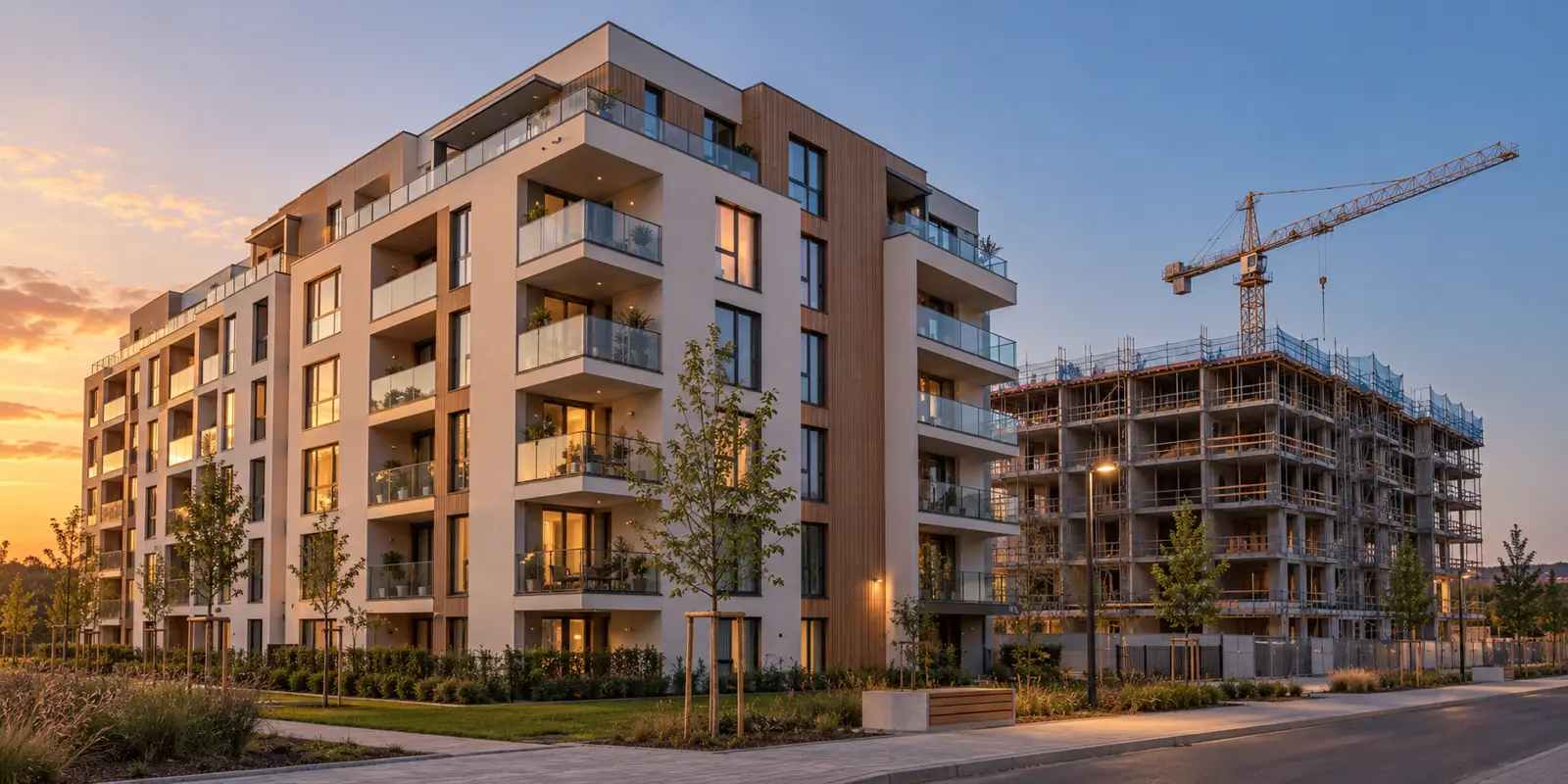
Buying off-plan means buying a flat from a developer before the building is finished, often before it's started. You choose a flat from the plans, sign contracts that promise it to you, and pay part of the price as the building goes up. In law, though, the flat doesn't exist yet. It becomes a unit you can own only when the building is approved for use and the flat is entered in the land register (katastr nemovitostí). Until then, what you have is a contract with the developer. That's why the contracts, and where your money waits, matter more than with an ordinary purchase.
How is buying off-plan different?
With a flat that already exists, you check it, sign one purchase contract and pay the price into escrow on the same day. Off-plan, the same purchase is spread over the life of the building:
| Step | What you sign | What you pay | When |
|---|---|---|---|
| Reservation | A reservation agreement (rezervační smlouva) | A reservation fee | When you pick the flat |
| Future contract | A future purchase contract | Usually the first instalment of the price | Within the weeks after the reservation |
| Construction | Nothing new, unless you ask for changes | Further instalments, if the contract has them | As the building goes up |
| Approval and the unit | Nothing: the building office approves the building for use, and the developer registers the flats | Nothing | When the building is finished |
| Purchase contract | The purchase contract (kupní smlouva) | The rest of the price, usually into escrow | When the developer calls you to sign |
| Handover and the land register | The handover record (předávací protokol) | Nothing | After the purchase contract |
The step-by-step guide to buying a flat covers the parts every purchase shares: the papers, the escrow and the land register. This guide covers what's different when the flat isn't built yet.
Step 1: The reservation
The developer takes the flat off its price list for you, usually for a few weeks, while you arrange the money and read the future contract. The law has no special rules for a reservation agreement: it's a contract the two sides shape themselves.1 So read what it says about the fee:
- Is the fee counted towards the price?
- Do you get it back if your bank won't lend, or if you and the developer can't agree the future contract?
- What does the developer owe you if it sells the flat to someone else, or never sends you a contract?
The last question matters because of a rule for contracts with consumers. A clause that lets a business keep what you paid when you don't sign, while you'd get nothing fair if the business didn't sign, is always abusive.2 An abusive clause doesn't count, unless you choose to rely on it yourself.3
Step 2: The future purchase contract
The future purchase contract (smlouva o smlouvě budoucí kupní) is the one that matters most. In it, the developer promises to sell you the flat, and you promise to buy it, once it exists. The law asks only that the future contract's content be agreed at least in general terms, and that the real contract be signed when one side calls on the other to sign it: in the period the two sides agreed, or otherwise within a year.4 Once called on, the other side must sign without undue delay.5 If it refuses, a court can set the contract's terms.6 If nobody calls on the other side in time, the duty to sign simply lapses.7
So the details have to be in the future contract itself. Have a lawyer read it, in your language, before you sign. It should say:
- The flat. Its number, floor, floor plan and floor area, and how the area is measured. Also what happens to the price if the finished flat comes out larger or smaller.
- What comes with it. A cellar or storeroom, a parking space, a garden or terrace, and whether each is part of the flat or a separate unit with its own price.
- The standard of finish (standard provedení): floors, tiles, doors, windows, the kitchen if there is one, and heating. The finished flat must match what the contract describes, or the sample or model it refers to.8
- The price and everything that can change it, including VAT.
- The payment schedule. How much is due, when, against which milestone, and into which account.
- The deadlines. When the building should be finished, when the developer will call you to sign the purchase contract, and a final date after which you may withdraw and have your money back.
- The penalties, both ways. What the developer pays you for each day it's late, and what you pay if you are.
- Client changes (klientské změny). Whether you can change the layout or the finish, by when, and at what price.
How is your money protected?
Until the land register enters you as the owner, the flat isn't yours.11 If you pay the developer directly and it fails before then, you're one of the people it owes money to. Most of the protection therefore comes from where your payments go:
| Protection | How it works | What to check |
|---|---|---|
| Escrow (úschova) with a lawyer or a notary | The money waits with them and goes to the developer only when the conditions you agreed are met, such as the entry in the land register | A written escrow contract, or the notary's record of the escrow, with the conditions for release12 |
| A bank guarantee (bankovní záruka) | The developer's bank promises in writing to pay you back up to a stated sum if the developer doesn't13 | That the guarantee covers everything you pay, and lasts until the flat is yours |
| The project's bank account | The developer's lending bank receives buyers' payments into an account it watches | Which bank, and what the bank does with the money if the project stops |
Escrow with a lawyer has one more safety net. The Czech Bar Association's guarantee fund pays people harmed by a lawyer's crime with an escrow, up to 5,000,000 Kč when the money is the price of a home.14
A payment schedule that asks for most of the price before the building exists puts the most money at risk. Ask whether the instalments can wait for the purchase contract, or go into escrow until then.
What does VAT do to the price?
A developer sells a new flat with VAT (DPH). The first sale of a finished flat is taxed until the end of the 23rd month after the month it was finished. A later sale is usually exempt.15 A flat bought from a private owner carries no VAT.
The rate depends on the flat's size. A unit that's only a home of up to 120 m² of floor area, with any rooms used with it, carries the reduced rate of 12 %. Larger homes carry the standard rate of 21 %.16 If parking or a storeroom is sold as a separate unit, ask what rate it carries. Check that the prices in the contract say whether they include VAT, and what happens if the rate changes before you pay.
What happens when the building is finished?
A building that needed a building permit may be used only once the building office has approved it for use, in a decision called the kolaudační rozhodnutí.17
To sell the flats, the developer divides the building into units in a declaration (prohlášení vlastníka). A flat becomes a unit, something you can own, when the declaration is entered in the land register.18 That can happen before the building is approved: the law lets a unit arise once the building is closed in by its outer walls and roof, and the flat by its own walls.19
Once the building is approved, the developer calls you to sign the purchase contract, as the future contract set out. From here the purchase works like any other:
- The purchase contract must be in writing.20
- The rest of the price goes into escrow, your own money and the mortgage.
- The application for entry goes to the cadastre office. It may enter you no sooner than 20 days after notifying the current owner,21 and the entry takes effect from the moment the application arrived.22
The handover and defects
At the handover you inspect the flat and sign the handover record (předávací protokol). Take your time, and if you can, bring someone who knows buildings. Check every window, door, tap, socket and tile, and the floor area against the contract. Write every defect into the record, however small, with a deadline for the developer to fix it. From the handover, the risk of damage to the flat is yours.23
Your rights if the flat has a defect come from the Civil Code, and a contract can't take them away from a consumer:24
- A flat is defective if it doesn't have the qualities and finish the contract describes.25
- If the defect is a serious breach of the contract, you may ask for a repair or a fair discount, or withdraw from the contract. If it isn't serious, you may ask for a repair or a discount.26
- Tell the developer about a defect without undue delay once you could have found it.27 For a hidden defect in the building, you have at most five years from acquiring the flat.28
- If a defect shows within two years of the handover, it's presumed to have been there at the handover, unless the kind of defect rules that out.29
Many developers also give a guarantee (záruka za jakost) on top of these rights, for example on the building or on the equipment. Its length and what it covers are whatever the guarantee says.30
Can you get a mortgage on a flat that isn't built?
Banks lend against a home they can value and pledge, and until the flat is a unit in the land register, and yours, there's nothing for you to pledge. So the instalments under a future contract usually come from your own savings, and the mortgage (hypotéka) pays the rest of the price once the flat exists. Some banks will lend earlier against other security. Ask your bank, or a broker, before you sign the future contract, and make sure its payment schedule fits the bank's.
ČNB's limits apply as for any home: a loan of at most 80 % of the value, or 90 % if you're under 36 and buying your own home.31 The value is the bank valuer's, set once the flat is finished, so it may differ from the price you agreed years earlier. A long build also means the rate you were quoted at the start may not be the rate you sign. The mortgage guide explains the limits and the fixed rate, and the mortgage calculator works out what a bank could lend you.
What if the building is late?
New buildings are often late: permits, builders and materials all slip. The future contract decides what happens, so before you sign, check that it has:
- a date for finishing the building, and a penalty for each day the developer is late;
- a final date after which you may withdraw and have every payment back, with any penalty owed;
- no clause that lets the developer move the dates on its own.9
If your mortgage offer, your lease or your move depends on the date, leave room for a delay.
New builds for sale
How much more, or less, does a new build ask per square metre? Here is today's gap in Prague and in Brno between new builds for sale and the flats whose listing states any other condition:
These are the newest flats for sale in Prague in new builds, projects or buildings under construction:
The map shows every one of them. Zoom in on a development to see its flats side by side, and open one to see its fair price.
You can also see every new build for sale, or only new builds in personal ownership with an energy class of B or better. For the words on a listing, from novostavba to úschova, see the property glossary.
What is a smlouva o smlouvě budoucí?
A future contract: a contract in which one or both sides promise to sign another contract later. Off-plan, the developer and the buyer promise to sign the purchase contract once the flat exists. It must agree the purchase at least in general terms, and the purchase contract is signed when one side calls on the other, in the period agreed or otherwise within a year.
When do I become the owner of an off-plan flat?
When the land register enters you, after the building has been approved for use, the flat has become a unit and you've signed the purchase contract. Until then you have a contract with the developer, not the flat.
Is VAT included in the price of a new build?
A developer's sale of a new flat carries VAT: 12 % for a home of up to 120 m² of floor area, 21 % for a larger one. Check that the contract says whether its prices include VAT.
Do I get the reservation fee back?
It depends on the reservation agreement, so read it before you pay. In a contract with a consumer, a clause that lets the developer keep the fee when you don't sign, while you'd get nothing fair if the developer didn't, is abusive.
How long do I have to claim defects in a new build?
Tell the developer without undue delay once you could have found the defect. For a hidden defect in the building, you have at most five years from acquiring the flat, and a defect that shows within two years of the handover is presumed to have been there at the handover.
Sources
-
Civil Code (Act 89/2012 Coll.), §1746(2). ↩
-
Civil Code, §1814(1)(c). ↩
-
Civil Code, §1815. ↩
-
Civil Code, §1785. ↩
-
Civil Code, §1786. ↩
-
Civil Code, §1787(1). ↩
-
Civil Code, §1788(1). ↩
-
Civil Code, §2095 and §2096. ↩
-
Civil Code, §2051. ↩
-
Civil Code, §1105. ↩
-
Advocacy Act (Act 85/1996 Coll.), §52e(1), and Notarial Code (Act 358/1992 Coll.), §87 and §88(1). ↩
-
Civil Code, §2029. ↩
-
Advocacy Act, §29a(2). ↩
-
VAT Act (Act 235/2004 Coll.), §56(1) and (2). ↩
-
VAT Act, §47(1), §48a(5) and §49(3)(d). ↩
-
Building Act (Act 283/2021 Coll.), §230(1). ↩
-
Civil Code, §1164(1). ↩
-
Civil Code, §1163. ↩
-
Civil Code, §560 and §2128(1). ↩
-
Cadastre Act (Act 256/2013 Coll.), §18(1). ↩
-
Cadastre Act, §10, and Civil Code, §1105. ↩
-
Civil Code, §2121(1). ↩
-
Civil Code, §1814(1)(a). ↩
-
Civil Code, §2099(1). ↩
-
Civil Code, §2106(1) and §2107(1). ↩
-
Civil Code, §2112(1). ↩
-
Civil Code, §2129(2). ↩
-
Civil Code, §2129(3). ↩
-
Civil Code, §2113(1). ↩
-
Czech National Bank, upper limits for the credit ratios LTV, DTI and DSTI, left unchanged on 4 June 2026. ↩