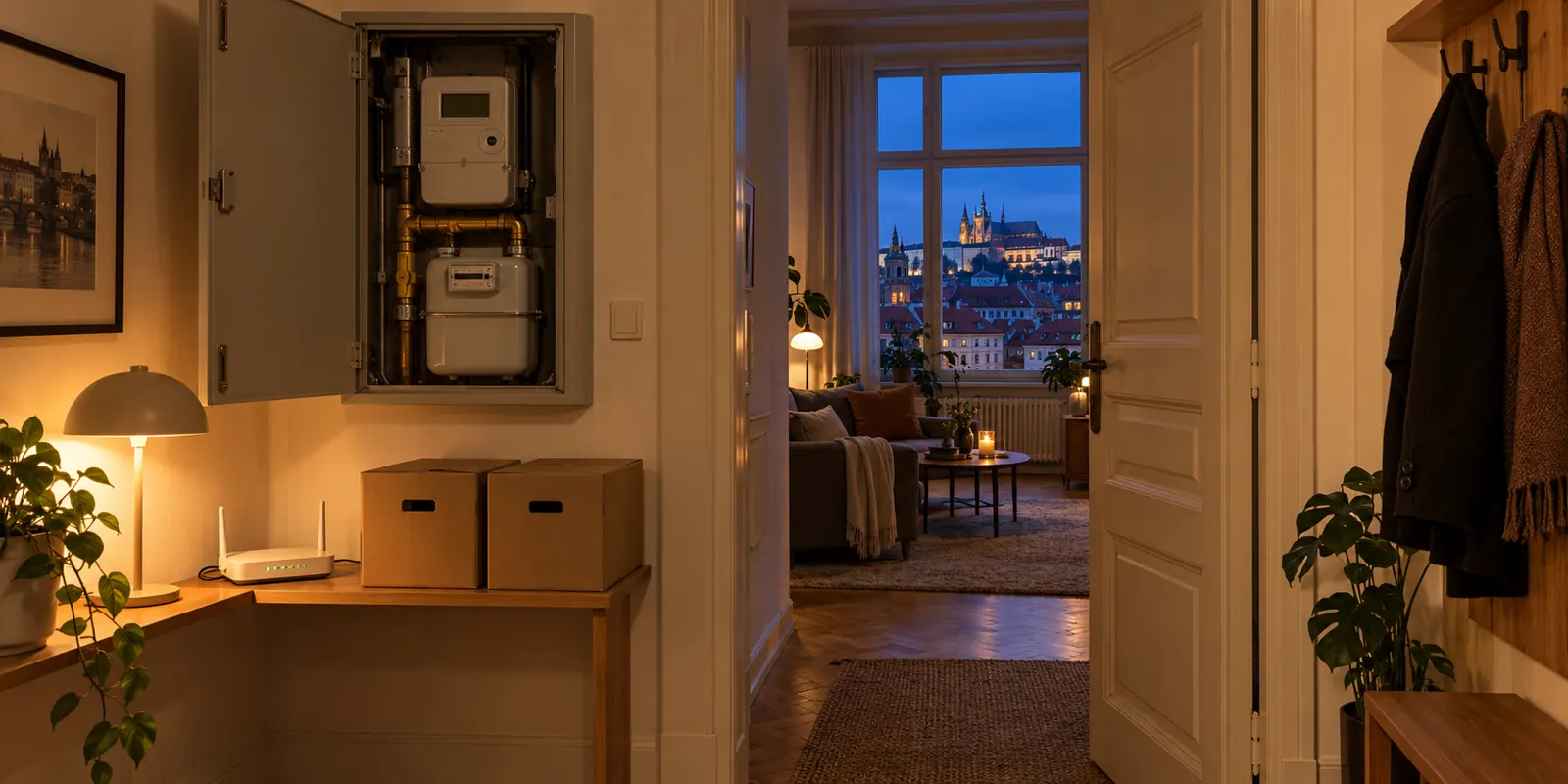
When you rent a Czech flat, the rent and the charges (zálohy na služby) pay for the building's services: heating and hot water from the building, water, the lift, cleaning and so on. The electricity you use in the flat, and gas if the flat has its own, usually aren't among them, and nor is internet.1 Those are contracts in your own name, and the law gives you, as a household customer, rights the contract can't take away. This guide covers who supplies what, what to do on the day you move in, switching, the bills, contracts signed at the door and internet.
Who's who: the network and the supplier
Two companies stand behind your electricity. The distributor (distributor) owns the wires and the meter. It's fixed by where you live, because each one holds a licence for its own territory.5 The supplier (dodavatel, or obchodník) sells you the energy, and you choose it freely from any licensed supplier.2 Gas works the same way. You usually sign one contract, with the supplier, which covers the network too, so you get one bill.
| Where you live | Electricity network | Gas network |
|---|---|---|
| Prague | PREdistribuce | Pražská plynárenská Distribuce |
| South Bohemia | EG.D | EG.D |
| South Moravia, including Brno, and Vysočina | EG.D | GasNet (EG.D around Pelhřimov) |
| Most of the rest of the country | ČEZ Distribuce (EG.D in parts of the Zlín and Olomouc regions) | GasNet |
The borders between networks don't follow the regions exactly, so check the last bill or ask the landlord.
Each place you're supplied (odběrné místo) has a code: an 18-digit EAN for electricity and an EIC for gas.6 Both are on every bill.7 With the code and the meter number, any supplier can find your flat.
Is it in your name or the landlord's?
The law's list of a building's services covers heating and hot water supplied by the building, water, the lift, the lighting and cleaning of the shared parts, waste and a few more. It doesn't include the electricity or gas you use in the flat.1 So there are two usual setups:
- The energy moves to your name. You sign with a supplier from the day you move in, and it bills you directly, with the rights this guide describes.
- The energy stays in the landlord's name. The landlord keeps the contract and passes the cost on, through the charges or by the meter. Ask how it's worked out and to see the supplier's bill.
Someone must have a contract for the flat: using electricity or gas with no contract is unauthorised consumption under the Energy Act.8
Where the building heats the flats and their water from its own boiler or from district heating, that's a service in your charges, and the gas the building buys for it is the landlord's.9 You'd have your own gas contract only if the flat has its own boiler or a gas cooker. The service-charge check reads the yearly settlement of the charges item by item.
Moving in
- Write down the meter readings. On the day you move in, note each meter's number and reading in the handover record (předávací protokol), and take dated photos. No law requires the record, but suppliers recommend it to settle the readings between the old customer and the new one.
- Choose a supplier and sign. The Energy Regulatory Office's price comparison lists suppliers' prices. Sign at least a few weeks before you move in: the supplier must tell the market operator by the tenth working day before supply starts.10 Suppliers usually ask for proof of your right to use the flat, such as the lease.
- The supply carries on. Your supplier registers the change of customer at the supply point, so the power doesn't go off between tenants.11
- The old tenant leaves their contract. Once their right to use the flat ends, they can end their contract on 15 days' notice, with no penalty.12
The readings at the change of customer are what the old and new bills are worked out from, and a reading you take yourself counts.13 For gas, the distributor takes the new customer's reading first.14 If you send a reading yourself, include the date, the EAN or EIC and the meter number.
Switching supplier
Switching is free, and the new supplier usually handles it, including giving notice to the old one on your behalf.2 How soon you can leave depends on your contract:
| Your contract | How it ends |
|---|---|
| Indefinite | A notice period of at most three months, from the first day of the month after the supplier receives your notice15 |
| Fixed-term | On its end date. A fixed term can be at most 36 months.16 If it renews automatically, you can give notice up to the 20th day before it ends, and the supplier must tell you the new terms 30 days before17 |
| Fixed-term, left early | A penalty is allowed only on a fixed-price contract, and the law caps it18 |
You can also leave without a penalty when the supplier raises its prices,19 and when you lose the right to use the flat, for example because your lease ends.12
Contracts signed at the door or on the phone
Energy sellers still knock on doors and call. If you signed a contract away from the supplier's premises, at your door, on the phone or online, you can withdraw from it within 14 days of signing, with no reason needed.3 If the seller came to your door without being asked, the Civil Code gives you 30 days. If nobody told you about the right to withdraw, the period runs a year longer.3 If supply has already started at your request, you pay for what you used.20
On top of that, if such a contract switched your supplier, you can end it at any time up to the 15th day after supply starts, with 15 days' notice. The same applies to a contract made through an intermediary.21 It's the supplier that must prove a contract wasn't made away from its premises.21
Some towns ban door-to-door selling by local regulation.22
The monthly advances and the yearly bill
You pay the supplier monthly advances (zálohy) and get a bill (vyúčtování) at least every 14 months, after a meter reading.23 The supplier may set the advances only as high as your reasonably expected use. If they look too high, ask for lower ones, and if the supplier won't, complain to the Energy Regulatory Office.24
| What | The rule |
|---|---|
| The bill | Within 15 days of the supplier receiving the meter data, and free25 |
| A complaint about the bill | Settled within 15 days26 |
| A late bill or a late answer | 50 Kč for each day from the 31st day late, up to 5,000 Kč27 |
| An overpayment | Paid back by the date the bill states, as your contract sets it28 |
When you move out, take the readings with the landlord, write them into the handover record and end your contract.12
Internet
Internet is a contract with an operator, separate from energy. Ask the landlord what the building already has: a fibre or cable connection, a phone line, or nothing, in which case mobile internet with a home router may be the quickest choice. Before you sign, the operator must give you a free summary of the contract, and a contract made online or on the phone takes effect only once you confirm it after receiving the summary.29
- The term. A fixed term can be at most 24 months. Anything longer counts as an indefinite contract.30
- Leaving early. If you end a fixed-term contract within three months of signing, the operator can charge at most a twentieth of the monthly fees left. After three months, you pay nothing for the rest of the term.4 A discounted router or phone you keep is paid for separately.31
- After it renews. Once a fixed term has renewed automatically, you can leave free, with notice of at most a month.32
- A change of terms. If the operator changes the terms on its own, you can leave free within a month.33
- Signed at the door or on the phone. The same 14 or 30 days to withdraw apply, from the day after you receive the written information.34
Every word you'll meet on a bill or in a lease, from energie to vyúčtování, is in the property glossary. The moving checklist puts the energy among the other things to sort out in your first weeks.
Do I have to change the electricity into my name?
Only if the landlord doesn't keep it in theirs. The electricity you use in the flat isn't one of the building's services, so usually you sign with a supplier yourself. If the landlord keeps the contract, ask how they'll pass the cost on.
Can I choose my electricity supplier?
Yes. You choose any licensed supplier, and switching is free. The network company, which owns the wires and the meter, depends on where you live.
How long does switching take?
The new supplier must register the switch by the tenth working day before supply starts, and your old contract must end first: an indefinite one after at most three months' notice, a fixed-term one on its date.
What if I signed an energy contract at the door?
You can withdraw within 14 days of signing, or 30 days if the seller came uninvited. If it switched your supplier, you can also end it up to the 15th day after supply starts.
What happens when I move out?
Take the meter readings with the landlord, write them into the handover record and end your contract. Once your lease ends, you can end an energy contract on 15 days' notice, with no penalty.
Can I leave an internet contract early?
After the first three months, yes, without paying for the rest of the term. Within the first three months, the operator can charge at most a twentieth of the monthly fees left.
Sources
-
Act 67/2013 Coll., on services connected with the use of flats, §3(1). ↩ ↩2
-
Energy Act (Act 458/2000 Coll.), §28(1)(b) and (e), and §62(1)(b). ↩ ↩2 ↩3
-
Civil Code (Act 89/2012 Coll.), §1829(1), (3) and (4), and §1829a; Energy Act, §11b(2). ↩ ↩2 ↩3
-
Electronic Communications Act (Act 127/2005 Coll.), §63b(8). ↩ ↩2
-
Energy Act, §25(1)(a). ↩
-
Decree 408/2015 Coll., on the rules of the electricity market, §16(2); Decree 349/2015 Coll., on the rules of the gas market, §2(1)(g). ↩
-
Decree 207/2021 Coll., on billing for electricity and gas, §6(3)(a) and §10(3)(a). ↩
-
Energy Act, §11r(1). ↩
-
Decree 408/2015 Coll., §33(2); Decree 349/2015 Coll., §110(3). ↩
-
Decree 408/2015 Coll., §40(1); Decree 349/2015 Coll., §113(5). ↩
-
Decree 359/2020 Coll., on electricity metering, §7(3)(b) and §8(6). ↩
-
Decree 108/2011 Coll., on gas metering, §5(2)(b). ↩
-
Energy Act, §11c(4). ↩
-
Energy Act, §11d. ↩
-
Energy Act, §11c(1) and (2). ↩
-
Energy Act, §11cc(1) and (2), in force from 1 August 2025. ↩
-
Energy Act, §11a(6). ↩
-
Civil Code, §1834. ↩
-
Energy Act, §11p, and Act 128/2000 Coll., on municipalities, §11(1). ↩
-
Energy Act, §11(7). ↩
-
Energy Act, §11(6). ↩
-
Energy Act, §11(1)(f) and §11(10). ↩
-
Energy Act, §11(14). ↩
-
Energy Act, §11(15). ↩
-
Decree 207/2021 Coll., §6(1)(c). ↩
-
Electronic Communications Act, §63(5) and (6). ↩
-
Electronic Communications Act, §63b(1). ↩
-
Electronic Communications Act, §63b(7) and (9). ↩
-
Electronic Communications Act, §63b(3). ↩
-
Electronic Communications Act, §63b(5). ↩
-
Civil Code, §1829 and §1829a; Electronic Communications Act, §63(12). ↩