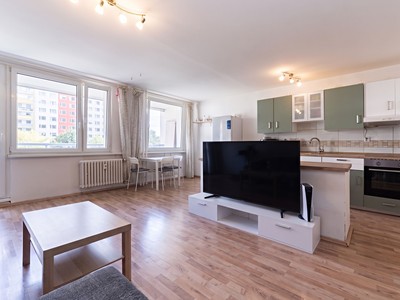
A cooperative flat (družstevní byt) is a flat in a building that a housing cooperative (bytové družstvo) owns. Its members each hold a share in the cooperative (družstevní podíl), and the share carries the right to lease one of its flats.1 So when you "buy" a cooperative flat, the seller transfers their share to you and you become a member, and the cooperative's tenant of that flat. The land register shows the cooperative as the building's owner, not you.2 Many Czech listings sell flats this way, and the papers to check differ from a flat in personal ownership. This guide isn't legal advice: have a lawyer read the transfer contract before you sign.
What do you own?
The share is a set of rights and duties that come with membership.1 In a housing cooperative, the main right is a lease of your flat, for an indefinite term. The Civil Code's lease rules apply to it, alongside the cooperative's articles (stanovy), as far as the articles don't conflict with the law.3 Your lease lasts as long as your membership: the cooperative can't give you notice the way a landlord can, but if it expels you as a member, the lease ends.4
| Personal ownership | Cooperative | |
|---|---|---|
| In Czech | osobní vlastnictví (OV) | družstevní vlastnictví (DV) |
| What you own | The flat as a unit, with a share in the building's common parts | A share in the cooperative, with the lease of the flat |
| The land register | Shows you as the owner | Shows the cooperative as the owner of the building2 |
| How it changes hands | A purchase contract, entered in the land register | A transfer contract, delivered to the cooperative5 |
| Who runs the building | The owners, through the owners' association (SVJ) | The cooperative's members' meeting and board, under its articles |
| A mortgage on it | The flat is the bank's security | Not possible on the share alone6 |
Can foreigners buy property in Czechia? explains personal ownership and how to read the land register.
How does the transfer work?
The seller and you sign a contract transferring the share (smlouva o převodu družstevního podílu). The law sets no form for it, because a share isn't real estate,7 but have it in writing, signed by both of you, and drafted or read by a lawyer. If the seller is married and the share belongs to both spouses, both of them sign.8
The transfer takes effect towards the cooperative on the day the cooperative receives the signed contract, or a joint declaration from you both that the share has been transferred, unless the contract sets a later day. From then on you're the member and the tenant, and the seller's membership ends.5
Only someone who can become a member under the law and the articles can acquire a share.9 In a housing cooperative, the articles can't limit or rule out a transfer to a buyer who meets their conditions for membership.10 Some cooperatives' articles still mention their board's consent, so ask the cooperative before you sign how it handles a transfer.
| Step | Who | What happens |
|---|---|---|
| Ask for the papers | You, through the seller | The articles, the last accounts and a confirmation of what the seller owes |
| Sign the transfer contract | You and the seller | The price, the day of the handover and who pays the seller's debts |
| Pay into escrow | You | The price waits with a notary, an attorney or a bank |
| Deliver the contract | Either of you, or both together | The transfer takes effect towards the cooperative |
| Release and handover | The escrow holder and the seller | The seller is paid and you get the keys |
There's no land register entry and no cadastre fee, because there's nothing to enter.2 There's no property transfer tax either: it was abolished in 2020, and a share isn't real estate anyway.11
What to check before you pay
The papers tell you what you're joining. Ask for them before you agree a price.
- The articles (stanovy). They set the conditions for membership, how the monthly payments are worked out, the rules on subletting and whether members can be asked to pay more. You'll find the full text, and the cooperative's accounts, in the Collection of Deeds (sbírka listin) of the public register at or.justice.cz, under the cooperative's name.12
- The seller's debts to the cooperative. The debts the seller owes the cooperative for the use of the flat pass to you with the lease.13 The seller stays liable for them too,14 but you'd rather not chase them. Ask the cooperative for a written confirmation of what the seller owes, dated just before you sign, and have the contract say that the seller pays it.
- The cooperative's loans. A loan the cooperative took for the building is the cooperative's debt, not yours, but the members repay it through their monthly payments, under the articles.15 Ask what part of yours goes to a loan and for how many more years. Some listings show a price that leaves out the flat's part of the cooperative's loan (anuita), which the buyer takes over. Bytky doesn't estimate a rental yield for those listings, because the price alone would mislead.
- The monthly payments. The cooperative may charge its members only the costs it reasonably spends on the building, such as repairs, modernisation and its loans, plus the services.15 Ask for the amount, what it covers and the last yearly settlement of the services. The service-charge check reads a settlement item by item.
- Extra payments. The articles can let the cooperative ask its members for more: a higher basic contribution, up to three times the current one and at most once in three years, or a share of a loss, also capped. Neither applies unless the articles provide for it.16
- Pledges and enforcement. A share can be pledged.17 Ask the seller and the cooperative to confirm in writing that the share isn't pledged or seized.
- The building. Its state, the works planned and how the members voted on them. Ask for the minutes of the last members' meetings.
Letting a cooperative flat
If you might let the flat, read the articles first. You can sublet part of the flat while you live in it without asking. To sublet the whole flat, or part of it while you live elsewhere, you need the cooperative's written consent. It counts as given if the cooperative doesn't answer within a month, unless a ban on subletting was agreed.18 Subletting without consent is a gross breach of your lease, and the cooperative can expel you for it, which ends the lease.19
Can a cooperative flat become yours outright?
Some cooperatives transfer their flats to their members in personal ownership. You have no right to demand it: it's the cooperative's decision, under its articles.20 Older cooperatives, set up before 1992 and built with state aid, can transfer flats to their members for free, if they decide to, once each member has repaid their share of the cooperative's outstanding loans.21
Ask whether the members have ever voted on it, what the articles say and what it would cost you. A listing that promises a transfer "soon" is promising something only the cooperative can decide.
How do you pay for it?
A mortgage (hypoteční úvěr) is a loan secured on real estate,6 and a share isn't real estate, so a bank can't take the flat as its security the way it would with a flat in personal ownership. Loans to pay for a cooperative share do exist, though, and the law treats them as housing loans, with the same protection for you as a borrower:22
- A loan secured on other property, such as a flat you or your family own.
- A building-savings loan (úvěr ze stavebního spoření), which the law allows to pay for the transfer of a cooperative share.23
- An unsecured housing loan.
- A pledge of the share itself, which the law allows,17 if the bank accepts it.
Which of these a bank offers, and on what terms, is up to the bank. Ask before you agree a price, and see getting a mortgage in Czechia as a foreigner for what banks ask of foreign borrowers.
Escrow
Pay the price into escrow, not to the seller directly. A notary, an attorney or a bank holds the money and releases it to the seller only when what the escrow agreement names has happened.24 An attorney's escrow needs a written agreement and a separate account.25 For a share, a sensible condition is the cooperative's written confirmation that it has received the transfer contract and that you're now its member and the flat's tenant.
Can foreigners buy one?
Yes. The law sets no nationality condition for membership of a cooperative: only the conditions in the law and in the cooperative's articles count.9 The old limits on foreigners buying Czech property were lifted in 2011.26 A bank's conditions for lending are a separate question, covered in the mortgage guide.
Cooperative flats for sale
These are the newest cooperative flats for sale in Prague:
The map shows every one of them. Open one to see its fair price against similar flats nearby.
You can also see every cooperative flat for sale, and compare them with flats for sale in personal ownership. For the words on a listing, from družstevní byt to osobní vlastnictví, see the property glossary.
Do I own a cooperative flat?
No. You own a share in the housing cooperative, which owns the building and leases you the flat for as long as you're a member. The land register shows the cooperative as the owner.
Can the cooperative refuse to accept me?
Not if you meet its articles' conditions for membership. In a housing cooperative, the articles can't limit or rule out a transfer to such a buyer.
Is the transfer entered in the land register?
No. It takes effect towards the cooperative when the cooperative receives the signed transfer contract. Nothing goes to the land register, and there's no property transfer tax.
Can I get a mortgage on a cooperative flat?
Not one secured on the flat, because a share isn't real estate. Banks lend for a share in other ways: against other property, as a building-savings loan, unsecured or against a pledge of the share.
Do I take on the seller's debts?
The seller's debts to the cooperative for the use of the flat pass to you with the share. Ask the cooperative to confirm them in writing before you sign, and have the contract say that the seller pays them.
Can I let my cooperative flat?
You can sublet part of it while you live there. To sublet the whole flat, you need the cooperative's written consent, which counts as given if it doesn't answer within a month, unless subletting was banned.
Sources
-
Cadastre Act (Act 256/2013 Coll.), §3(1) and §11(1). ↩ ↩2 ↩3
-
Business Corporations Act, §741(1) and §742(a). ↩
-
Business Corporations Act, §734(2) and (3). ↩
-
Civil Code (Act 89/2012 Coll.), §498(2) and §559. ↩
-
Civil Code, §714(1), and Business Corporations Act, §739(1). ↩
-
Business Corporations Act, §735(1) and §736(1). ↩
-
Act 386/2020 Coll., Article I(1), in force from 26 September 2020. ↩
-
Public Registers Act (Act 304/2013 Coll.), §66(a) and (c). ↩
-
Business Corporations Act, §736(2). ↩
-
Business Corporations Act, §601(1) and §736(3). ↩
-
Business Corporations Act, §566(1) and (4), §587 and §588(1). ↩
-
Civil Code, §2274 and §2275. ↩
-
Civil Code, §2276, and Business Corporations Act, §734(1)(a) and (3). ↩
-
Business Corporations Act, §751(1) and (3). ↩
-
Act 311/2013 Coll., on the transfer of cooperative flats, §1(a) and §9(1). ↩
-
Consumer Credit Act (Act 257/2016 Coll.), §2(2)(b). ↩
-
Building Savings Act (Act 96/1993 Coll.), §6(1)(h). ↩
-
Notarial Code (Act 358/1992 Coll.), §81(1)(c) and (2). ↩
-
Advocacy Act (Act 85/1996 Coll.), §52e(1) and §52g. ↩
-
Act 206/2011 Coll., amending the Foreign Exchange Act (Act 219/1995 Coll.) by repealing its §17, in force from 19 July 2011. ↩