


Moving house in Prague takes more than a van. You agree a contract with a moving firm, reserve a space on the street, hand one flat back and take another over, move the meters and tell the offices your new address. This guide takes them in the order you'll meet them, with the law behind each step, and ends with what changes when you move from abroad.
Plan the move: what to do when
| When | What to do |
|---|---|
| As soon as you know the date | Give notice on the old flat, or check when its lease ends. Book a moving firm. |
| Six weeks or more before | Apply for a reserved space for the van, if you need one. |
| A few weeks before | Ask both buildings about their rules for moving. Sign up for electricity, and gas if the new flat has its own.7 |
| About a week before | Put up the parking signs as your permit says, if you have one. Plan what goes to a collection yard. |
| Moving day | Hand over the old flat and take over the new one, each with a record and the meter readings. |
| In the weeks after | Report your new address, then change your ID card, car and anything else that carries it. |
The end-of-lease tool works out the day your lease ends and when the deposit is due back, and prints your notice in Czech. Move-in costs adds up the cash you need before you get the new keys.
Still looking for the next flat? These are the newest flats to rent in Prague:
Choosing a moving firm
A firm that carries your things for pay runs road transport for others, which needs a concession, whatever the size of its vans. The trade register is public, so you can look the firm up by its name or company number (IČO) before you book.8
What you agree is a contract for the carriage of a thing (smlouva o přepravě věci): the firm carries your things to the new address, and you pay for it.9 Get these in writing:
- The price, and how it's worked out: by the hour or for the job, with or without packing, and what the floors, the stairs and the distance add. If you agree no price, the firm is owed the usual price at the time you made the contract.10
- The date and the time. The firm must carry your things within the agreed time, or without undue delay if you agreed none.10
- What it's carrying. You must tell the firm correctly what it carries, so list what's fragile or valuable. On request, the firm must confirm in writing that it has taken your things over.9 Ask for that confirmation, with the list, at the old flat.
- Who packs. If you pack yourself and bad packing causes damage, the firm isn't liable if it warned you when it took the things over, or couldn't have seen the problem.1 If the firm packs, say so in the contract.
- Insurance. Ask whether the firm's insurance covers the things it carries, and up to what sum. The firm is liable either way, but its insurance decides whether it can pay a large claim.
If something breaks
The firm is liable for damage to your things from the moment it takes them over until it hands them over, unless it proves it couldn't have prevented the damage even with professional care. Nor is it liable for damage you caused, or damage that comes from the nature of the thing itself. A clause in the contract that limits this liability is disregarded.1 For a lost thing, it pays what the thing was worth when it took it over; for a damaged one, the loss in that value. That's not the price of a new one. The firm must also tell you of any damage without undue delay.11
Check your things as they come off the van, write any damage on the delivery note and photograph it. Claim it from the firm within six months of the day you took delivery (or, if nothing arrived, the day it was due): after that, a court won't award it if the firm objects that you're late.12
Booking online or by phone
You can usually withdraw from a contract made online or by phone within 14 days, but not from one for carrying goods on a set date or within a set period.13 Once you've booked a date, you can cancel only on the contract's terms, so read them before you book.
A move across a border
The international convention on road haulage (CMR) doesn't apply to removals.14 For a move across a border, what your contract says about liability, and which law it chooses, matter all the more. Read them before you sign.
Help from a professional
Get a moving firm for your move
Bytky is choosing a few moving firms. Leave your details and we'll email you to ask about the move: the date, the size of each flat, the floors and any large items. Then we'll write to you when a firm is ready.
We don't pass your details to anyone without asking you first, naming who it is.
Parking the van
Stopping to load
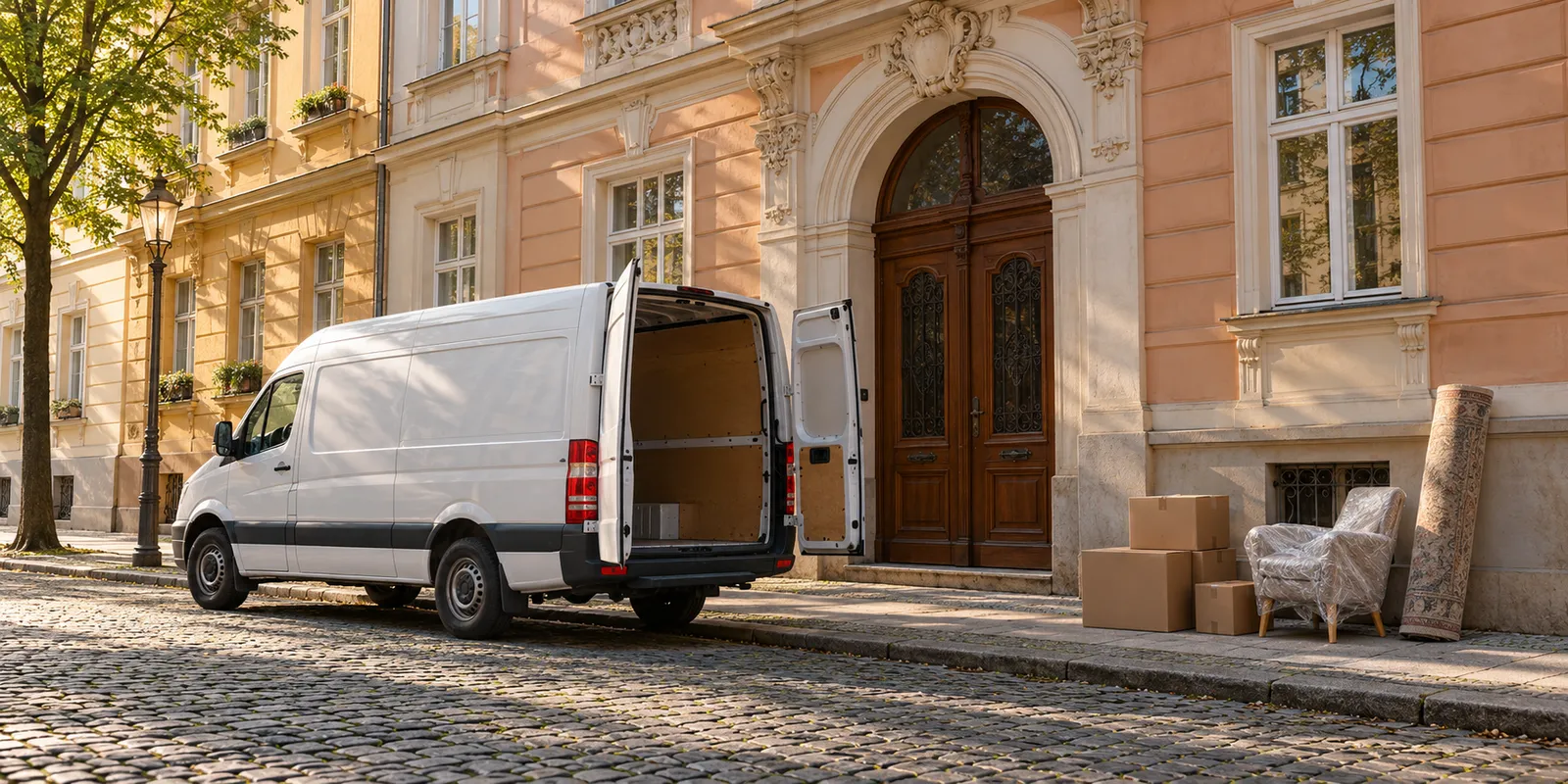
A van may stop for as long as it takes to load or unload without delay. Under a no-standing sign (B 29) it can do that, but under a no-stopping sign (B 28) it can't stop at all. Even when it stops, a lane at least 3 m wide must stay free for traffic in both directions, and when it stands, one for each direction.15 On a narrow street, that can rule out stopping by the door at all.
Reserving a space (zábor)
Taking space on a street for longer, by reserving parking or leaving things on the pavement that aren't moved at once, is special use of the road. It needs a permit from the road office, issued with the consent of the road's owner, and with the police's consent where it may affect safety or the flow of traffic.2 In Prague it's called a zábor.
- Who decides. For most streets, the transport department (odbor dopravy) of your city district. On the roadway of a main road (a class I local road), City Hall (Magistrát) decides.16 Districts say which streets are whose: Praha 2, for one, lists them street by street.17
- The road's owner. In Prague that's usually the city's road company, TSK (Technická správa komunikací). It offers a lease of street space for short-term parking, meant for moves. You apply online, in person, by post or by data box, and it usually answers within 10 working days. You then take the lease, with a traffic plan (DIO), to the district, and the lease takes effect only once the permit is issued.18
- What the application needs. The exact place, the purpose and the dates, how it'll be done, the details of the person responsible and the effect on traffic.19 Districts ask for a site plan with measurements, often in three copies, and the owner's consent. Some take an application only by data box or with an electronic signature.3
- How long it takes. No district publishes a minimum lead time. Praha 7's page on building zábory gives 30 days from the application, and Praha 5 says 30 to 60 days.3 Add TSK's lease, and apply six weeks or more before the move.
- The signs. Once you have the permit, you arrange the temporary signs through a specialist firm of your choice.18 Put them up as the permit says; a week ahead is a sensible margin. If a car still stands in your space, call the city police (156), who decide whether it's towed. Praha 2 warns you may have to pay for the tow and claim it back from the car's owner.20
Ask the moving firm whether it applies for the permit and the signs for you, and for a copy of the permit if it does.
What it costs
The permit and TSK's rent are separate payments. A local fee is due only for uses the law lists: reserving a space for a few days isn't one, but things stacked on the pavement can count as a skládka. Ask the district's finance department.21
| Payment | To whom | How it's worked out (2026) |
|---|---|---|
| Administrative fee for the permit | The district, or City Hall on a main road | 100 Kč for up to 10 days22 |
| Local fee for using public space | The district, or City Hall on a main road | Only for listed uses, such as a skládka, up to 10 Kč per m² a day; ordinance 16/2025 and its annexes set where and how much23 |
| Rent for the space | TSK, under its lease | TSK sends the amount with the lease18 |
If it applies and the use lasts up to 6 days, report it at least a day before you start; it's due on the first day.23 Leaving things on the street or reserving a space without a permit is an offence, with a fine of up to 500,000 Kč (2026).24
Building rules
Moving day crosses the shared parts of two buildings. As a tenant, you follow the building's usual rules and your landlord's reasonable instructions for keeping order. A flat's owner must follow the building's rules, which in an owners' association (SVJ) are in its statutes, and make tenants follow them too.25 Before the day, ask your landlord or the building's manager:
- whether you can use the lift for furniture, and whether it must be protected;
- whether the building sets hours for moving, and where the van may stand if there's a courtyard;
- who to tell if a shared door must stay open.
No law sets daytime hours for moving, but night-time quiet runs from 22:00 to 06:00, and disturbing it is an offence with a fine of up to 10,000 Kč (2026).26 If your new landlord owns a unit in the building, they must tell the building's manager who lives in the flat and how many people, so the building learns of your move that way.27
Handing over the old flat and taking over the new one
On the day you leave, you hand the flat back in the state you took it over in, apart from normal wear and defects your landlord should have fixed. Hand it back late, and you owe rent for every day until you do.28 On the day you move in, the new flat should be clean and in good order, with its essential services working, unless the lease says otherwise.29
Write both handovers into a record (předávací protokol): each room's state, the keys and the meter readings, with dated photos. The handover record prints one in Czech with English under each line. The moving-out record is your evidence about anything taken off the deposit, which the landlord returns with interest when the lease ends, less what you owe.30
Reader poll
The last time you moved out of a rented home, did you get your whole deposit back?
Anonymous, one answer per browser. We use the answers to learn who reads Bytky.
Meters, energy and internet
Write each meter's number and reading into both records: the old and the new bills are worked out from them. Once your old lease ends, you can end the energy contract there on 15 days' notice, starting on the first day of the month after the supplier receives it, with no penalty.31 For the new flat, sign with a supplier a few weeks ahead. If you change supplier, the new one must register the change by the tenth working day before supply starts; staying with the last tenant's supplier has no such deadline.7 Electricity, gas and internet in a Czech flat explains the rest, including internet contracts.
Bulky waste
Furniture and mattresses you don't take go to a collection yard (sběrný dvůr), or to a large container that a city district puts out on set days. You can use any district's container, not only your own.32 The yards are free if you're 15 or older and prove permanent residence (trvalý pobyt) in Prague; the city's leaflet asks for an ID card (občanský průkaz). Without permanent residence in Prague you can still hand waste in, for a charge. Old electrical appliances are free for everyone.33 At the city's yards, each person can hand in up to 750 kg of bulky waste a calendar year.34 Leaving things by the bins or on the street is an offence.35 Waste and recycling lists what goes where.
Changing your address
Czech citizens
You report a new permanent address (trvalý pobyt) at the registration office (ohlašovna) for the new address. In Prague, that's the office of the city district. You go in person and fill in the form there, or send someone with a power of attorney that carries your certified signature. Bring your ID card and a document showing your right to live in the flat, such as the lease. Without one, bring the owner's written consent with a certified signature, or have the owner confirm it on the form in front of the clerk.36 The fee is 50 Kč for everyone on one form, and children under 15 are free (2026).37
There's no deadline and no fine, because the law doesn't make you register where you live.38 Registering gives you no rights to the flat, and none against its owner.36 Reporting the move sets off a few changes:
| What | What to do | By when |
|---|---|---|
| ID card | Apply for a new one at a district office in Prague (Praha 1 to 22) or any municipal office with extended powers. It's free at the standard term (2026). | The old one stops being valid 45 days after you report the move. Apply within 15 days after that.4 |
| Car | Apply to change the address in the vehicle register, and get a new registration certificate: 50 Kč, or 40 Kč on the Transport Portal (2026). | Within 10 working days. Missing it can bring a fine of up to 50,000 Kč (2026).39 |
| Health insurer | VZP takes a permanent address from the register itself. If you live somewhere else, give your insurer an address for post. | No deadline40 |
| Tax office | If you're registered for a tax, report changes, except data the office reads from public registers, such as the address of someone with Czech permanent residence (trvalý pobyt). | Within 15 days41 |
| Driving licence | Nothing: it doesn't show your address. | —42 |
Foreigners
A foreigner reports a move to the Ministry of the Interior, or to the police, by a deadline set by their status:5
| Your status | Deadline | If you'll live there |
|---|---|---|
| Long-term visa or long-term residence permit | 30 days | longer than 30 days |
| Permanent residence, not an EU citizen | 30 working days43 | longer than 180 days |
| EU citizen with a registration certificate or permanent residence | 30 working days | longer than 180 days |
| EU citizen who only reported to the police | 30 working days, to the police | longer than 180 days |
| Temporary protection | 3 working days | longer than 15 days |
A long-term residence permit card doesn't show your address, so reporting a move costs nothing. If you're a permanent resident from outside the EU, your card shows your address, so report the move promptly. You get a new card, for 1,000 Kč, or 500 Kč under 15. An EU citizen pays 200 Kč to change a registration certificate or permanent residence document (2026).44 A foreigner also tells their health insurer of a new address within 30 days.40 If you're registered for a tax, tell the tax office within 15 days.41
Register your address explains where to go and what to bring, and the notice of changes fills in the form for you.
Moving from abroad
From another EU country
Moving your household between EU countries involves no customs formalities.45 Alcohol and tobacco bought for your own use in another EU country and carried by you come in free of Czech excise duty. The law gives guide amounts, such as 10 litres of spirits, 90 litres of wine, 110 litres of beer and 800 cigarettes (2026), and more can still count as your own use if everything else points that way.46
From outside the EU
Your personal property can come in free of import duty, and so of VAT, when you move your normal residence to Czechia, if:6
- you've lived outside the EU for at least 12 months in a row;
- except in special cases, you've had the things in your possession, and used those that don't get used up, for at least six months before you left, and you'll use them the same way here;
- nothing about their kind or amount suggests trade.
Personal property covers household effects, bicycles and motorcycles, private cars and their trailers, caravans, boats and private aircraft, household provisions, pets and saddle animals, and the portable instruments of your profession. Alcohol, tobacco, commercial vehicles and work equipment other than portable instruments are left out.6
You declare the things within 12 months of taking up residence, in one go or in several lots.6 They can also come before you, if you undertake in writing to move within six months and leave a security for the duty and VAT, which you get back once you prove you've moved.47
Bring a list of the things detailed enough to match them, the registration certificate of any vehicle, whose VIN customs checks, and proof that you lived abroad, such as a lease, insurance, bank statements or an employment contract. The request has no set form.45 A customs representative can handle the procedure for you, so you needn't be there.48
For 12 months after customs accepts the declaration, tell customs before you lend, pledge, hire out or sell the things. Doing any of these in that time makes the duty payable.49 Bringing a car? Importing a car covers its registration.
Do I need a permit to park a moving van in Prague?
Not to stop and load where stopping is allowed, as long as you load without delay and leave a lane free. To reserve a space, or to leave things on the street, you need a permit for special use of the road from the district or City Hall, with the road owner's consent.
How far ahead should I apply for the zábor?
No office sets a minimum, but TSK's lease usually takes up to 10 working days, and districts take up to 30 days or more to decide. Apply six weeks or more before the move.
Is the moving firm liable if it breaks something?
Yes, from the moment it takes your things over until it hands them over, unless it proves it couldn't have prevented the damage. For loss, it pays the thing's value when it took it over; for damage, the loss in that value. Claim within six months of delivery.
Can I cancel a moving firm I booked online?
Not under the 14-day rule for online contracts, because it doesn't apply to carrying goods on a set date. You can cancel on the contract's terms, so read them before you book.
Do I have to report my new address?
A Czech citizen doesn't have to, but once they do, their ID card stops being valid after 45 days. A foreigner must, by a deadline set by their status.
Can I bring my things from outside the EU without paying duty?
Yes, if you lived outside the EU for 12 months, had and used the things for six, and declare them within 12 months of moving. Alcohol, tobacco and commercial vehicles are left out.
Sources
-
Roads Act (Act 13/1997 Coll.), §25(1), (2) and (6)(c), points 2 and 4. ↩ ↩2
-
Praha 7, special use of roads and building zábor; Praha 5, special use of roads; Praha 3, application for special use of a road. ↩ ↩2 ↩3
-
Identity Cards Act (Act 269/2021 Coll.), §9(1), §11(b) and §34(2)(a); Portál občana, a new ID card after a change of permanent residence. ↩ ↩2
-
Foreigners Act (Act 326/1999 Coll.), §98(1), (3) and (6); Lex Ukrajina (Act 65/2022 Coll.), §6(10); Ministry of the Interior, "Change of address", ipc.gov.cz. ↩ ↩2
-
Council Regulation (EC) No 1186/2009, articles 2 to 7; VAT Act (Act 235/2004 Coll.), §71(2)(b)(1). ↩ ↩2 ↩3 ↩4
-
Decree 408/2015 Coll., on the rules of the electricity market, §33(2) and §40(1); Decree 349/2015 Coll., on the rules of the gas market, §110(3) and §113(5). ↩ ↩2
-
Road Transport Act (Act 111/1994 Coll.), §4; Trade Licensing Act (Act 455/1991 Coll.), annex 3 and §60(3). ↩
-
Civil Code (Act 89/2012 Coll.), §2555(1), §2556 and §2557(1). ↩ ↩2
-
Civil Code (Act 89/2012 Coll.), §2558 and §2564. ↩ ↩2
-
Civil Code (Act 89/2012 Coll.), §2567(1) and (2) and §2568. ↩
-
Civil Code (Act 89/2012 Coll.), §1829(1) and §1837(j). ↩
-
Convention on the Contract for the International Carriage of Goods by Road (CMR), published as 11/1975 Coll., article 1(4)(c). ↩
-
Road Traffic Act (Act 361/2000 Coll.), §2(n) and (o) and §25(3); Decree 294/2015 Coll., on road traffic signs, signs B 28 and B 29. ↩
-
Statute of the City of Prague (ordinance 55/2000), annex 4, points 12(d) and 25(f), consolidated text as of 1 October 2026; City of Prague, events in public space. ↩
-
Praha 2, where to apply for a zábor. ↩
-
Technická správa komunikací hl. m. Prahy, short-term parking (zábor). ↩ ↩2 ↩3
-
Decree 104/1997 Coll., implementing the Roads Act, §40(1) and (3). ↩
-
Praha 2, questions and answers on zábory, question 17. ↩
-
City of Prague, events in public space; Praha 2, questions and answers on zábory. ↩
-
Administrative Fees Act (Act 634/2004 Coll.), tariff item 36(a). ↩
-
Local Fees Act (Act 565/1990 Coll.), §4(1) and (4); Prague ordinance 16/2025 on the fee for using public space, §2(1), §3(1), §4(1), §6 and §7(1), and annexes 1 and 2, in force from 1 January 2026. ↩ ↩2
-
Roads Act (Act 13/1997 Coll.), §42a(1)(b) and (8)(a). ↩
-
Civil Code (Act 89/2012 Coll.), §1176, §1200(2)(f) and §2256(2). ↩
-
Act 251/2016 Coll., on certain offences, §5(1)(d), (3)(b) and (7). ↩
-
Civil Code (Act 89/2012 Coll.), §2292, §2293 and §2295. ↩
-
Civil Code (Act 89/2012 Coll.), §2242 and §2243. ↩
-
Prague ordinance 20/2022 on waste, §4(3) and (6); City of Prague environment portal, where to take each kind of waste. ↩
-
City of Prague, collection yards leaflet, February 2025; Pražské služby, collection yards. ↩
-
Prague ordinance 21/2024, art. I points 4 and 8, amending §4(3) and §14(1) of ordinance 20/2022, from 1 January 2025. ↩
-
Waste Act (Act 541/2020 Coll.), §61 and §117(1)(c). ↩
-
Act 133/2000 Coll., on the register of residents, §10(2), (5), (6) and (11); Portál občana, reporting a change of permanent residence. ↩ ↩2
-
Administrative Fees Act (Act 634/2004 Coll.), tariff item 2(c). ↩
-
Ministry of the Interior, reporting permanent residence. ↩
-
Road Vehicles Registration Act (Act 56/2001 Coll.), §11(1) and (2)(a), and §83(1)(c) and (2)(c); Administrative Fees Act (Act 634/2004 Coll.), §9 and tariff item 26(g). ↩
-
Public Health Insurance Act (Act 48/1997 Coll.), §12(k) and (l); VZP, which personal details to report. ↩ ↩2
-
Tax Procedure Code (Act 280/2009 Coll.), §127(1) and (4); Financial Administration, registration data you needn't report. ↩ ↩2
-
Ministry of the Interior, "Change of address", ipc.gov.cz. ↩
-
Foreigners Act (Act 326/1999 Coll.), §103(e) and §117a(3)(b)(2); Administrative Fees Act (Act 634/2004 Coll.), tariff item 116(3) and (5); Ministry of the Interior, "Change of address", ipc.gov.cz. ↩
-
Customs Administration, moving house, celnisprava.gov.cz. ↩ ↩2
-
Excise Act (Act 353/2003 Coll.), §4(5) and §32(1) to (4). ↩
-
Council Regulation (EC) No 1186/2009, article 9(1); Customs Administration, moving house. ↩
-
Union Customs Code (Regulation (EU) No 952/2013), article 18(1); Customs Administration, moving house. ↩
-
Council Regulation (EC) No 1186/2009, article 8(1) and (2). ↩