

The building act rewrite is signed: what changes for neighbours, buyers and new builds
Parliament passed a big amendment to the Czech building act over the Senate's veto, and the President signed it. A first set of changes starts on the first day of the month after it's published, most of the rest on 1 January 2027.
Published 7 min read
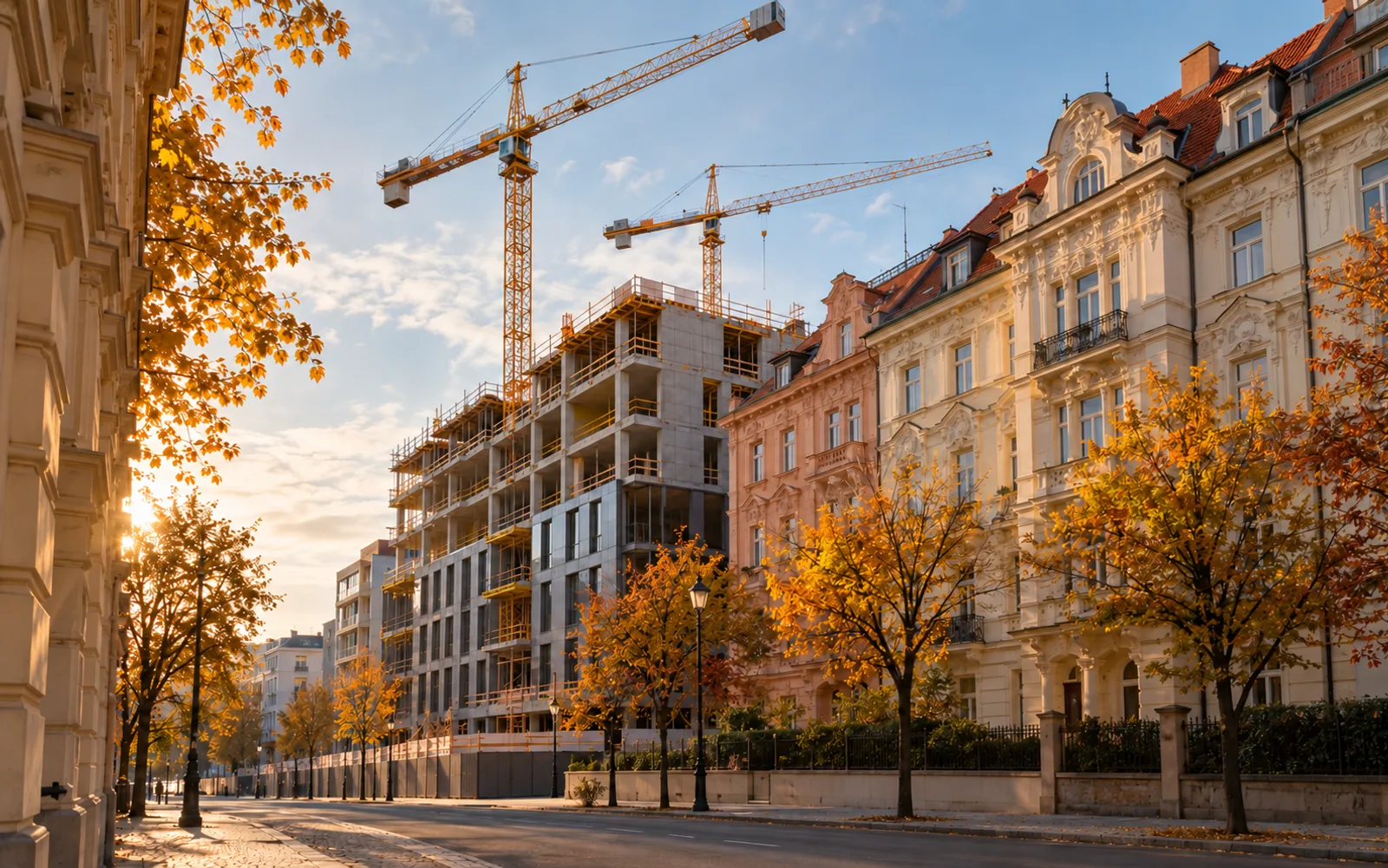
Illustration: Bytky
Contents
What has Parliament decided?
Parliament has rewritten large parts of the building act (Act No. 283/2021), the law under which every new home in Prague gets its permit. A group of ten deputies proposed the amendment in December 2025, and the government backed it. The Chamber passed it on 10 July by 88 votes to 79. The Senate rejected it on 20 August, and on 9 September the Chamber kept its version with 105 votes, four more than it needed. The President signed it on 17 September, and it was sent for publication on 19 October, the Chamber's record shows.
The aim, says the explanatory report, is one procedure "run, as a rule, by one office, ending in one permit" (our translation).
When does it start?
In three steps, set out in the law's last article. A first set of changes starts on the first day of the month after the law is published in the Collection of Laws. Most of the rest starts on 1 January 2027, and a few parts on 1 January 2028.
As of 31 October, it hadn't been published: the newest act in e-Sbírka, the official Collection, was No. 207/2026, from 30 October. Until it appears there, none of it applies.
What changes first if a project is planned next door?
Neighbours get less time and narrower grounds. Once the first changes apply, the law as passed says:
- 10 days to object. The building office invites objections "within 10 days of the invitation being delivered" (our translation). Today, when there's no hearing, it must give at least 15 days. If the office holds a hearing, objections can still be made there, and it must announce the hearing at least 10 days ahead, not 15.
- A week for bias. An objection that an official is biased must come within a week of learning of it, with reasons and evidence.
- Only broken rules count. "Objections that don't rest on a breach of legal rules are not well-founded" (our translation).
- Zoned land is presumed fine. A project on land the zoning plan marks for building, in line with the plan and the building requirements, is presumed acceptable, also under other laws the plan took into account. It's presumed to respect neighbours' rights if it meets the requirements and fits "the planned character of the area, the usual surrounding buildings or the usual use of the surrounding area" (our translation).
- Your SVJ speaks for you. When flat owners are participants, their owners' association (SVJ) represents them, not only when it's the builder, as today. An owner can still tell the office they don't want that.
Builders gain: a project is judged under the rules on the day of the application, even on appeal, and the office must hear the builder before refusing.
Arnika, an environmental group, says the changes weaken people's rights in favour of building. Its expert: "People and towns will have only ten days to file objections" (our translation).
What changes in court?
A permit becomes harder to stop, from the first set of changes. The extra two-month window to add new grounds to a lawsuit goes, and claims that turn on objections the law tells the office to disregard are inadmissible. A request to suspend a permit can only come with the lawsuit; if a court grants it, it must decide within 90 days. A court won't annul a permit where that would harm others or the public interest disproportionately more than refusing harms the person who sued, who can then claim damages from the state.
What changes for new homes?
Small blocks of flats get a quicker permit, and big housing projects go to the new state office from 2027. Everything below without a date comes with the first set of changes.
- Small blocks of flats become simple buildings: a footprint up to 500 m², at most four floors above ground and one below, up to 9 metres high as fire-safety rules measure it, only for housing. The office must decide on a simple building within 30 days, not 60. Today only buildings for housing with at most two floors above ground, one below and an attic count. They'll still need an occupancy approval (kolaudace).
- Big housing projects get their own category. A building or group of buildings mainly for housing with a total floor area of 10,000 m² or more becomes a "building for mass housing", which the explanatory report puts at roughly 100 to 200 flats. Public infrastructure and "reserved buildings" are declared a public interest, and from 1 January 2027 these housing projects join the reserved buildings, which the new state office permits.
- The affordable-rental route ends. Special permit rules for affordable rental housing are repealed. Unless the municipality was the builder, they needed a contract with it to rent at least 80% of the floor space at affordable rents for at least 20 years. The report says they didn't prove themselves in practice.
- Finishing is quicker. An authorised inspector can issue the occupancy decision instead of the building office, if the builder or owner asks, and an appeal against it no longer holds it up.
What starts on 1 January 2027, and in 2028?
On 1 January 2027 most of the amendment's other changes apply, and the Territorial Development Office of the Czech Republic (Úřad rozvoje území) starts. It replaces the Transport and Energy Building Office (Dopravní a energetický stavební úřad), which closes on 31 December 2026, and takes over the ministries' work as building offices. The old implementing rules stay until the government's new regulation takes effect, but not after 31 December 2027.
On 1 January 2028 its regional offices start. The building offices run by regions and towns close on 31 December 2027, and their staff and files, Prague's and its districts' included, pass to the state.
What does it mean if you rent or buy?
If a project is planned next door, open any letter from the building office the day it comes. You'll have 10 days to object, and your objection should name the rule you think the project breaks. If you own a flat, ask your SVJ's committee what it plans to do. Our free legal help page lists who can advise.
If you're buying off-plan, the new court rules make a permit harder to overturn, and an appeal no longer stops the occupancy decision. The law doesn't change your purchase contract: buying a new build off-plan covers what to check, panel, brick and the energy label how building types compare, and our buying topic the rest.
If you rent, nothing here changes your lease, which the Civil Code governs.
What happens next?
- Publication in the Collection of Laws; the first changes start on the first day of the following month.
- Possibly November: senators of the Mayors (Starostové) club said they intend to ask the Constitutional Court then to annul the amendment, ČTK reported; at least 17 senators must sign. We know of no filing.
- 1 January 2027: most of the amendment; the new office starts.
- 1 January 2028: the state's regional offices take over from the building offices of towns, Prague and its districts.
Quick answers
Is the amended building act in force?
Not yet. As of 31 October it hadn't been published in the Collection of Laws. The first changes start on the first day of the month after it is published, and most of the rest on 1 January 2027.
How long will I have to object to a project next door?
10 days from the building office's invitation, once the first changes apply, or at the latest at the hearing, if the office holds one; today, without a hearing, at least 15. Cases already running continue, as a rule, under the new rules, but the new deadlines start no earlier than the day they take effect.
Will my SVJ object for me?
It will represent you when flat owners are participants. If you'd rather speak for yourself, tell the building office.
Does this change my lease or my purchase contract?
No. Leases and purchase contracts follow the Civil Code, which the amendment doesn't change.
Has anyone challenged it in the Constitutional Court?
Not as far as we can find. On 30 September the chair of the Mayors' club of senators said they wanted to file in November.
Weekly email
Prague This Week
Every Friday morning, the week in Prague for people who rent, buy or live here. Short, free, and every story links to its source.
One email a week. Unsubscribe in one click.
We use your address only for this email. Privacy policy
More Prague news
All news News · City Hall
Prague's new assembly meets on Thursday: who will run the city, and what it means for housing
The 65 members elected in October take their oaths on 5 November, then plan to wait until 12 November to elect a mayor and council. STAN and Spolu are talking to Praha sobě and the Pirates this week, and all four promised more city flats.
Bytky News Desk · 2 November 2026 · 6 min read
 News · Transport
No trams between Florenc and Palmovka on 7–8 November, and what runs instead
Track repairs around Florenc change trams and buses from 2 to 13 November. The biggest change is the weekend: from Saturday to Monday morning no trams run between Florenc and Palmovka, and X3 buses take their place through Karlín.
Bytky News Desk · 3 November 2026 · 7 min read
 Explainer · Mortgages
The ČNB sets interest rates on Thursday: what it means for your mortgage
The Czech National Bank's board decides on 5 November whether to change its main rate, now 3.75%. Where the rate stands, how it reaches mortgages and refixes, and what it means if you rent or buy in Prague.
Bytky News Desk · 2 November 2026 · 6 min read