Homes in Czechia are expensive against Czech pay, and most of all in Prague. A typical flat asks many years of local pay in every region, and the further prices run ahead of pay, the less of the price the rent covers. So Prague costs the most years of pay and earns landlords the least on the price, while the old industrial regions of the north-west and north-east cost the fewest years, and their towns pay landlords the most back in rent. Here are the live figures, what drives them and what they mean for you. Czechia in numbers shows the same figures as maps and short loops you can try with your own pay or budget.
How many years of pay does a flat cost?
More than most people expect, everywhere. Take what a typical two-room flat for sale asks in a region and divide it by a year of the gross pay a typical employee there earns: the answer runs to many years in every region, and is highest in Prague. The live map at the top of Czechia in numbers hops from the region where a flat costs the fewest years of pay to the one where it costs the most.
Real life is harder: the figure counts pay before tax and assumes you spend nothing else. That's why almost every buyer borrows, and why the question that matters to you is how much of the price you need of your own.
Your pay isn't your region's typical pay, either. How many years of pay buy a flat? takes your pay, gross or take-home, and your savings, and works out every region again. If you rent, salary to rent turns the same pay into the rent it can carry.
Why does Prague cost so much more than the rest of the country?
Because Prague has the most jobs and the best pay, draws people from across the country and from abroad, and, as the city itself has said for years, doesn't build enough new flats for them. Typical pay in Prague is the highest of any region,1 but its flat prices are higher by far more than its pay is. Here's today's market in Prague and in Ostrava, the biggest city in Moravskoslezský kraj:
Brno, the second city, sits in between. Prices in Czech cities puts the big cities side by side, and compare two areas does it for any two places you're choosing between. Several things push Prague's prices up at once:
- Jobs and pay. Head offices, government, universities, finance and tech cluster in Prague, and so does much of the best-paid work.
- Too few new flats. A permit for a new block of flats has long taken years, above all in Prague, and builders and the city alike name it as a main brake on new homes.
- The cost of borrowing. When the Czech National Bank raised its rates sharply in 2021 and 2022 to fight inflation, many who would have bought kept renting, which added to demand for rentals. As rates came down, buyers came back.
- Students and newcomers. Prague and Brno have the biggest universities, and most people who move to Czechia from abroad, including many who came from Ukraine since 2022, start out renting in the big cities.
- Buyers who let. Small flats draw people buying to let as well as people buying a home, and in the historic centre, flats let to tourists by the night take homes off the long-term market.
The cheapest regions tell the same story in reverse. The coal, steel and heavy-industry areas of Ústecký kraj, Karlovarský kraj and Moravskoslezský kraj lost many of their jobs from the 1990s on, and parts of them have been losing people since. Fewer buyers for an older stock of flats keep prices low.
How many years of rent does a flat cost, and why do cheaper towns pay landlords more?
Years of rent divide a flat's price by a year of the rent it would let for, and the fewest years are where flats are cheapest. It's the gross yield turned upside down: divide 100 by the years and you have the gross yield in per cent. The second loop on Czechia in numbers colours all 77 districts by it, and How many years of rent buy a flat? works it out for a flat of your size, at your own rent if you like.
Rents and prices answer to different things. A rent comes out of a tenant's monthly pay, so it can only stretch so far above local earnings. A price rests on what buyers can borrow on top of their savings, and on what they expect the flat to be worth later. Where buyers trust a flat to hold its value and sell quickly, as in Prague, they accept a smaller return from the rent; where they don't, they want a bigger one. So a high gross yield usually comes with a low price, and with risk: a longer wait for a tenant, a slower sale and an older building to repair. Mountain resorts run the other way, as holiday-home buyers lift prices without lifting rents.
The table ranks Czech towns by the gross yield of a two-room flat, from today's listings:
How do prices change across Prague?
They're highest in the centre and fall as you move out along every metro line, while rents fall less, so a flat near the end of a line tends to cost fewer years of rent. The Prague loops on Czechia in numbers ride lines A, B and C station by station, for asking prices, rents and yields within a kilometre of each stop, and walk out from Staroměstské náměstí a kilometre at a time.
The centre is small, old and wanted by everyone: residents, buyers who see it as the safest place to own, and short lets to tourists. Further out, much of the city was built after the war, a lot of it as panel estates the metro lines were laid out to reach, and much of what's gone up since 2000 is away from the centre too. Tenants pay for a short trip into town, but less than buyers pay for a central address, so yields tend to rise as you go out. This table ranks Prague's city parts by gross yield, across flats of every size:
The Prague neighbourhoods guide describes each part of the city, and the public transport page explains the metro, trams and buses. To see what's on offer along a line, open the map and zoom in on its stations.
Do new builds cost more than older flats?
Yes: per square metre, new builds ask more than flats in any other stated condition. Across the whole country the gap looks larger than it is, because a large share of new flats go up in and around Prague and Brno, where every flat costs more. Within one city the comparison is fairer:
A new flat costs more to build, with scarce land in the big cities and dearer materials and labour. It's also a better product in ways your bills show: it needs less energy to heat, usually has a lift, a balcony and parking, and shouldn't need big repairs for years. And since so few are finished, buyers compete for them.
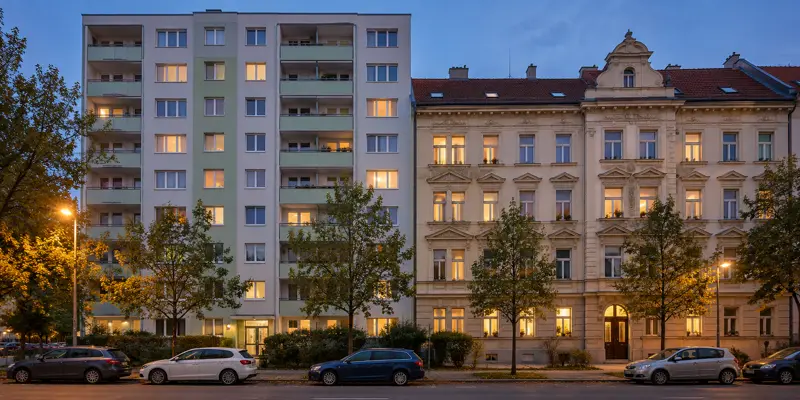
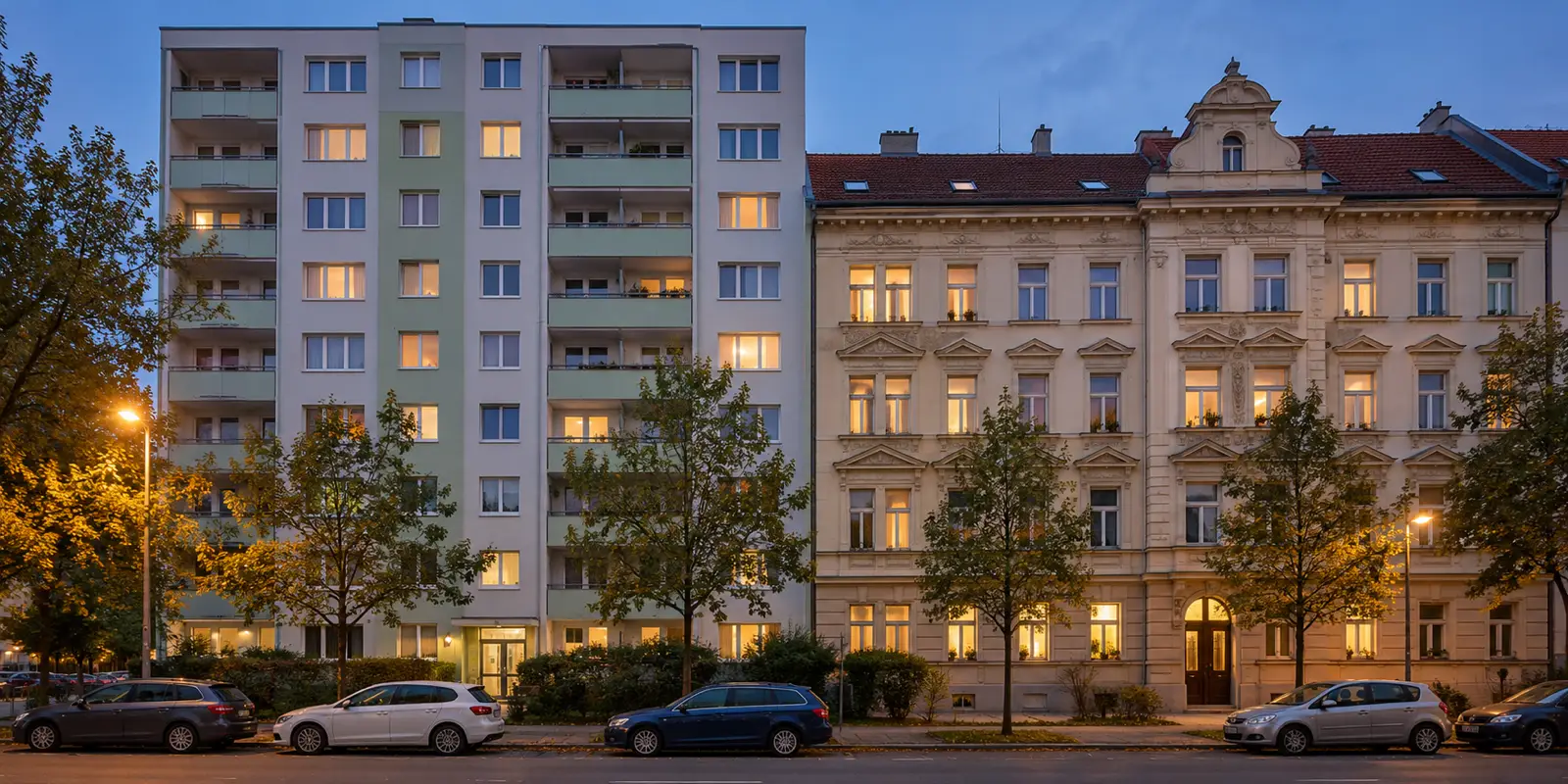
Older flats aren't one thing. Brick apartment houses from before the war are sought after in the centre, while panel blocks, built in their thousands from the 1960s to the 1980s, house a large share of Czech households and usually ask less per m². Here's how the flats for sale in Prague are built:
Panel, brick and the energy label explains what each kind of building means for comfort and bills, and buying a new build off-plan covers buying a flat that isn't finished yet.
Are prices going up or down?
Bytky has counted asking prices daily since October 2026, so it shows how they move from here on, not how they compare with five years ago. The chart follows what two-room flats for sale in Prague typically ask per m²:
For the longer view, the Czech National Bank weighs the same two yardsticks, prices against incomes and against rents, in its financial stability reports, and several have said that by these measures flat prices look high.2 That doesn't say where prices go next, only that the gap isn't just Prague's, and has lasted for years. And an asking price isn't the last word: many sellers cut theirs, as Is the asking price fair? shows.
What does this mean for me?
It depends on whether you rent, buy or invest. Each has its own next question, and a tool that answers it with your own figures.
If you rent
In Prague, rent takes a bigger share of pay than in most regions, so start from what your pay can carry: salary to rent turns it into a rent you can afford, by a common rule of thumb. Then use the gradient: a flat a few stops further out on the same metro line can leave you more each month for a trip that's only a little longer. Compare two areas sets places side by side, and what renting in Prague costs adds the charges, the deposit and the agent's fee. If you might buy one day, rent or buy compares the two over the years you expect to stay.
If you're buying a home
Start from your own figures, not the region's. How many years of pay buy a flat? shows how far your pay and savings go in every region, what your budget buys shows the floor space it gets you in each district, and the mortgage calculator works out what a bank could lend you. The Czech National Bank limits a mortgage on a home to 80 % of its value, or 90 % if you're under 36,3 so the rest, and the costs of buying, come from your savings. There's no tax on buying a home,4 but there are fees, a lawyer and the escrow: buying costs adds them up.
Before you make an offer, check the asking price against similar flats nearby with the price check. In Prague, a few stops further out, or a good older building instead of a new one, can buy you noticeably more space. What buying a flat costs and getting a mortgage as a foreigner go through each step.
If you're investing
Look at years of rent before price. How many years of rent buy a flat? shows where the rent pays the price back fastest, district by district, and the yield rankings do it town by town and across Prague's city parts. Then go from gross to net with the rental yield calculator: costs that come per flat, like the building's administration and insurance, take a bigger share of a small rent.
Weigh the yield against the risk. A high yield in a town that's losing people pays you for empty months and a slower sale; a low one in Prague buys a market where flats usually let and sell faster. For a flat bought to let, the Czech National Bank recommends a mortgage of at most 70 % of its value,3 so plan on more of your own money than for a home.
Where do the numbers come from?
From the asking prices and rents of the flats Bytky tracks, counted every day, and from ČSÚ for pay. A typical flat, price or rent here means the middle one: line up all the flats of that kind in a place, and half ask more while half ask less. A place needs enough flats on offer to get a figure, so a few odd listings can't swing it. Typical pay is the pay of the employee in the middle of the region's pay scale.1
They're asking prices, not the prices flats finally sell or let for, which can be lower. But they're what you're up against, counted the same way everywhere, so places compare fairly. How we count gives the details. Every loop on Czechia in numbers is a short video in English, Ukrainian and Czech, free to download and share: please credit bytky.com.
How many years of pay does a flat cost in Czechia?
Many in every region, and the most in Prague: what a typical two-room flat asks, against a typical employee's gross pay there. Czechia in numbers has the live figure for every region, and the years of pay tool uses your own pay and savings.
Where in Czechia does a flat cost the fewest years of rent?
In the cheaper towns of the old industrial north-west and north-east, where flats ask little and rents cover more of the price. The higher yield comes with more risk of empty months and a slower sale.
Are flat prices in Czechia rising or falling?
Bytky has counted asking prices daily since October 2026, so its charts show the trend from then on. Over the longer run, the Czech National Bank has said in several financial stability reports that flats look expensive against incomes and rents.
Can I share the loops?
Yes. Every loop on Czechia in numbers is free to download in English, Ukrainian or Czech and post anywhere. Please credit bytky.com.
Sources
-
Czech Statistical Office (ČSÚ), Struktura mezd zaměstnanců 2025, table B1: gross monthly pay by region, released 22 May 2026. ↩ ↩2 ↩3
-
Czech National Bank, Financial Stability Report, published each spring and autumn: its estimates of how far residential property prices are overvalued. ↩
-
Czech National Bank: the binding limit of 80 % of the property's value (90 % for applicants under 36 buying their own home), left unchanged on 4 June 2026, and its recommendation since 1 April 2026 of at most 70 % for a flat bought to let. ↩ ↩2
-
Act 386/2020 Coll., which abolished the property acquisition tax. ↩